What Is TypeSafe Jev? The Decision-Only AI Model, Explained
TypeSafe Jev picks answers, never writes them. What it costs, what it can't do, how to get access while signups are paused, and where it fits with human review.
— Craig Major
Short answer: TypeSafe Jev is a decision-only AI model from TypeSafe AI. Give it text, define the answers it may return, and ask it to choose, score or answer yes or no. It returns probabilities rather than a written explanation. That makes it a possible routing step in a workflow, provided people review uncertain or consequential cases.
Not the vaccine, not Jevons paradox
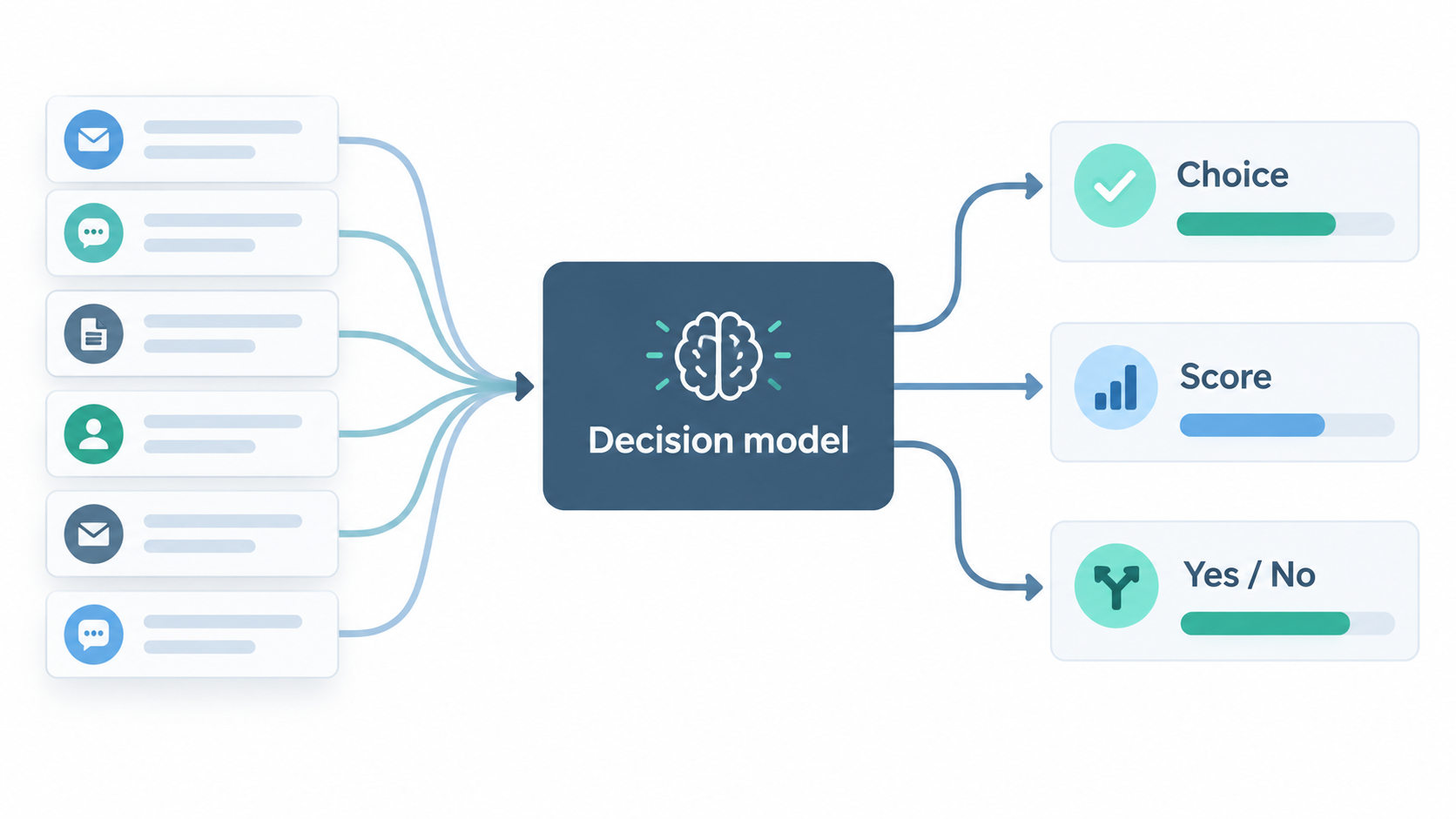
Search for “Jev” alone and you may find unrelated results. In this article, Jev means TypeSafe AI’s decision model, introduced in September 2026. TypeSafe calls its category a “System One Model”: a model designed for fast, structured decisions within software. The company says the name Jev refers to economist William Stanley Jevons. TypeSafe’s launch article explains the naming and the model’s intended role.
For a business, the question is whether a repeatable decision has a known set of answers. A model may sort routine cases; your rules and review process still govern the outcome.
How it works: Choice, Score and Yes/No
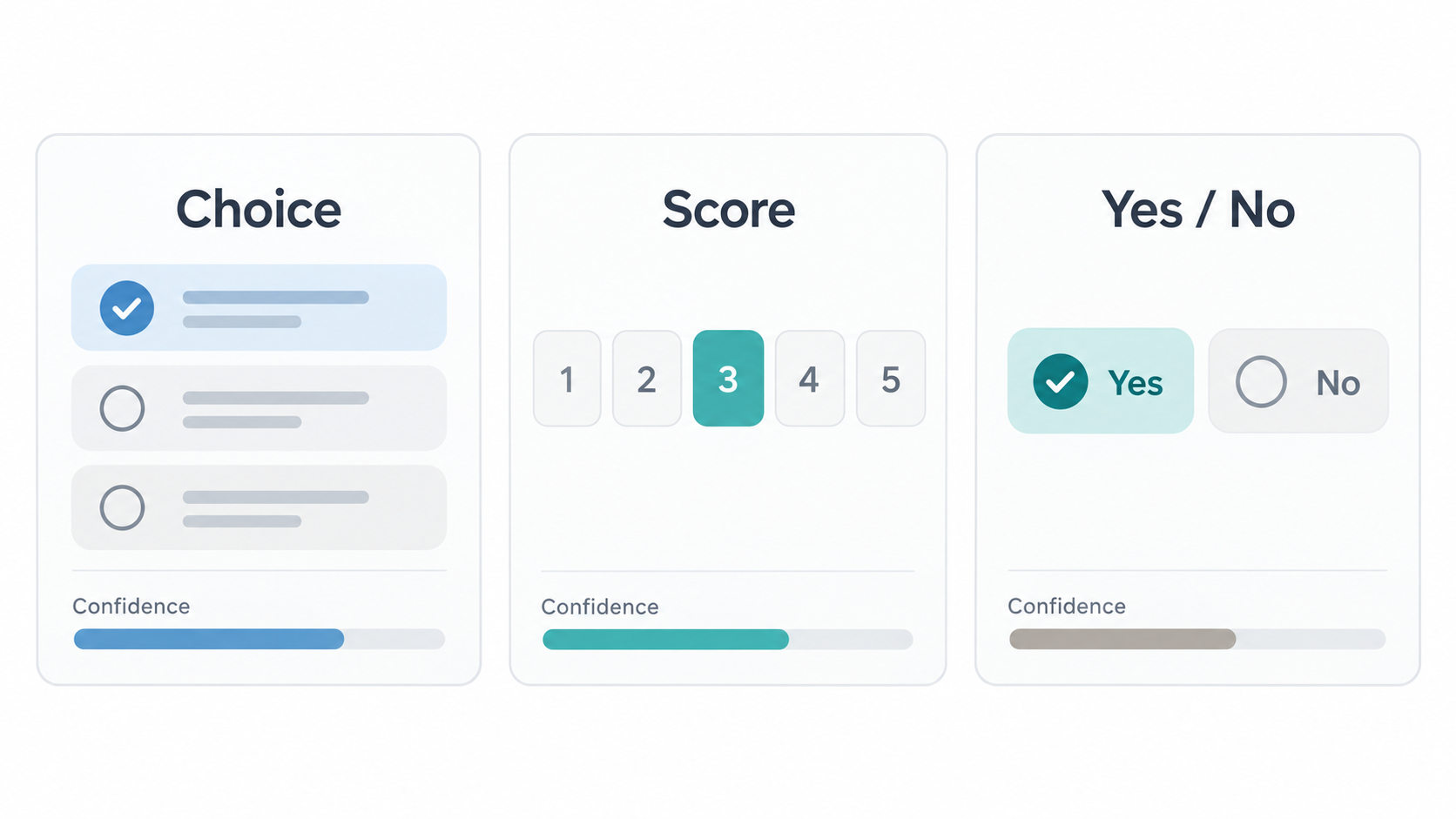
TypeSafe Jev accepts text and a question framed using one of three primitives. You specify the possible answers before the call. The response contains an answer and a probability. Think of that probability as a signal to test and set a review threshold around, rather than a guarantee of correctness.
| Question type | What you define | Example question | What the workflow receives |
|---|---|---|---|
| Choice | Up to 255 allowed options | Is this message about billing, support or sales? | One selected option and probabilities |
| Score | A scale with 2–10 levels | How ready is this lead for a sales conversation? | A level on your scale and probabilities |
| Yes/No | A binary question | Does this text ask to change a payment detail? | Yes or no and probabilities |
These are design examples, not Flowgrammer deployments. Define each label before use. “Billing” might include an invoice question but exclude a bank-change request that needs separate review. A model cannot settle an unclear policy.
Choice suits mutually exclusive categories; Score supports review bands; Yes/No tests a narrow condition. If text does not fit, send it to a person instead of forcing a label.
What it can’t do
Jev does not write an email, explanation or summary. If you need a customer-facing response, use a person or a separate writing tool after the decision step. The decision should be checked before anything is sent or changed.
It is text only. It cannot directly read an image, PDF or audio recording. A document workflow needs another step to produce text, such as OCR, before Jev sees it. A call workflow needs a speech or conversational component to handle the voice. Jev receives the resulting text or structured state; it is not the whole system.
TypeSafe also lists numeric precision, dates and multi-step reasoning among weak areas. Do not rely on Jev to calculate a total, establish whether an invoice is overdue, or apply a chain of financial rules. Use deterministic code or a responsible person for those jobs. A plausible answer can still be wrong, even when the output shape is valid.
Where it fits in a real workflow
“AI makes the routine call; a person handles the exceptions” is the design goal, not a performance claim. Before automating, decide what input arrives, which choices are permitted, what confidence band goes to review, and who can override the result. Human-led AI system design starts with that boundary. AI Automation Systems describes the broader implementation context.
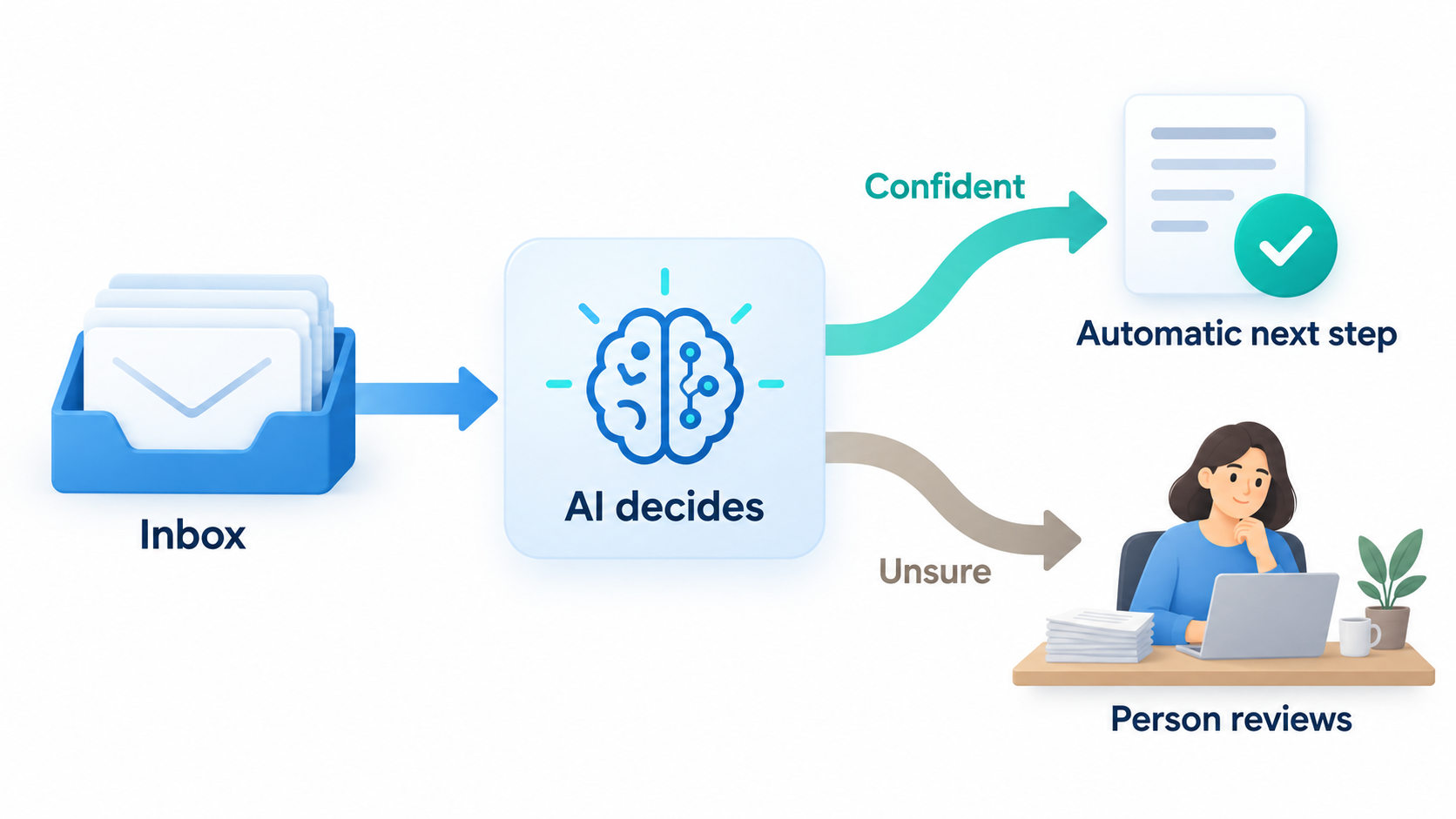
- Documents: OCR turns a PDF into text; the model may choose a document type; a person checks unclear or sensitive cases. The detailed pattern belongs in document classification after OCR.
- Accounts payable inbox: The system may sort text from incoming email into a triage lane. It should not approve payment or change bank details on the strength of that label. See AP inbox triage.
- Leads: A decision step may help classify whether a request matches a defined service. A salesperson remains responsible for qualification and relationship decisions. See lead qualification.
- Calls: A voice model can talk and transcribe while a decision model selects a route from allowed options. In the proposed pattern, “GPT-Live talks, Jev decides”; the human review and handoff rules still matter. See voice routing.
These are design patterns to test, not public Flowgrammer results. Compare model answers with labelled human decisions and inspect disagreements before automating.
What it costs
As checked on September 26, 2026, TypeSafe and the listed gateways show US$0.042 per million input tokens, with output free. The simple model charge is input tokens × US$0.042 ÷ 1,000,000. That is a model price, not a complete project budget. OCR, speech, gateways, integration, human review and monitoring may have their own costs. Re-check pricing before budgeting or publishing this page. TypeSafe pricing and the OpenRouter model page are the starting points.
TypeSafe made two statements about the price. In its September 15 launch article, it wrote: “We can’t prove it isn’t subsidized; we’ll need the long-term to prove the sustainability of our pricing”. In a homepage FAQ read September 26, the company wrote: “We can serve Jev profitably at our current prices.” The first acknowledges that future economics cannot yet be proven from a launch; the second is the company’s current position. Neither is a promise that your gateway price, contract or service costs will stay fixed.
How to get access today
TypeSafe said on September 22 that it would temporarily pause direct signups. It said signups were still closed on September 24. As of the September 26 check in this review, there was a waitlist and no verified reopening. Check the TypeSafe site again before telling a reader that direct access is available.
Jev was also listed through several gateways at that check:
| Channel | What to check before using it |
|---|---|
| OpenRouter | typesafe/jev-1.13 identifies a pinned version. |
| DigitalOcean | typesafe-jev-1.13.0 identifies a pinned version. |
| Cloudflare Workers AI | Confirm the listed model and regional data handling for your account. |
| Vercel AI Gateway | The research reports that this path cannot pin or report the resolved Jev version; verify before relying on reproducible results. |
“Jev Router” is a separate OpenRouter product. Do not assume it has the same behaviour or version as the pinned Jev model. Availability, model identifiers and prices can change, so this section needs a publish-day check.
Jev vs a general LLM
A general language model is useful when the job requires writing, summarising, conversation or flexible reasoning. Jev is built for a narrower job: answer a question from a set of allowed outputs. That can simplify the handoff to software because the result is already in a defined shape. It does not make the underlying judgement infallible. If the question is ambiguous, the labels are weak or the text is incomplete, a valid output can still be the wrong one.
In OpenRouter’s test of 3,080 support messages, OpenRouter reported 81.0% for Jev and 84.4% for Claude Opus 5, with a lower cost and time for Jev. Those are OpenRouter’s numbers for that classification setup, not a prediction for your inbox. Compare alternatives on your own labelled cases, including the cost of errors and review. The fuller comparison is TypeSafe Jev alternatives.
What skeptics say
A confidence score needs checking. Jev returns probabilities, but calibration can vary by task. One public calibration test found that a reported 0.85 on an offensiveness dataset aligned with people only about 45% of the time. A separate benchmark reported expected calibration error of 0.161 for Jev versus 0.064 for a frontier LLM. These are test-specific findings, not a universal reliability rating.
Benchmark design changes the story. TypeSafe’s own workflow evaluations use particular tasks and reference probabilities from other models. OpenRouter’s support-message exercise asks a different question. A vendor result, an independent test and your company’s cases can disagree without any one number settling the procurement decision.
The “zero-shot classifier” framing is useful. You supply answer options and ask for a selection without training on your examples. Calling it a classifier can clarify the job. It does not tell you whether it is accurate enough for a particular financial, customer or privacy decision.
The service is early. TypeSafe introduced Jev in early access in September 2026. Access limits, model versions and operating details may shift. Keep a version record and a fallback route if continuity matters.
Does it work in French?
One independent test used 500 human-translated short commands per condition across 60 intents. It reported 85% in English and 84% in French. That is a narrow test with France French and public data. It does not establish performance on Canadian business documents or Quebec French.
TypeSafe’s model notes say English is its primary training language and the language where accuracy is best. Treat French support as a question to test on your own labelled examples. Include the spellings, vocabulary and messy inputs your team actually receives, then review errors separately for each language.
Canadian data and privacy
The reviewed TypeSafe channels process Jev data in the United States; the research found no Canadian processing option. Routing through another gateway does not establish Canadian residency. Before sending customer, employee or financial text, confirm what is sent, what the provider retains, which agreements apply and who may access it. The fuller checklist is in TypeSafe Jev and Canadian privacy. This is general information, not legal advice. Check with your own lawyer about your data and your obligations.
FAQ
What is TypeSafe Jev?
TypeSafe Jev is a decision-only AI model from TypeSafe AI, introduced in September 2026. Give it text and a question whose possible answers you define. It returns a choice, score or yes/no answer with probabilities. It does not write an email or explanation. Its value depends on how well the question, labels, data and human review path fit your work.
How much does Jev cost?
At the September 26, 2026 check, the listed model price was US$0.042 per million input tokens, with output free. That excludes other workflow costs such as document extraction, speech, gateway charges, integration and human review. TypeSafe has discussed the sustainability of its launch price in different statements. Re-check the provider and gateway terms before budgeting.
Can I still sign up for Jev?
TypeSafe paused new direct signups on September 22, 2026 and said they remained closed on September 24. The research found a waitlist and no reopening by September 26. Jev was still listed through OpenRouter, DigitalOcean, Cloudflare and Vercel at that point. Check the current TypeSafe and gateway pages before choosing an access route.
Is Jev on OpenRouter?
Yes. At the September 26 check, OpenRouter listed the pinned model identifier typesafe/jev-1.13. Verify the listing and price when you use it. OpenRouter also lists “Jev Router,” which is a different product; its name should not be treated as a version of the pinned Jev model. Record the exact identifier in any comparison test.
Is Jev just a zero-shot classifier?
It can be understood that way for many tasks: provide a list of allowed answers and ask the model to choose without training on your examples. The description is useful, but it does not settle whether Jev is the right classifier for your data. Test it against your own labelled cases and inspect false routes and confidence before automating a consequential step.
Does Jev work in French?
A public test of short, translated commands reported 85% in English and 84% in France French. TypeSafe says English is where the model works best. Those results cannot establish how it will perform on your own French text or Quebec French. Build a labelled sample from your real inputs and compare errors, especially for cases that require a person.
Next step
If a decision step could help with a defined operational outcome, contact Flowgrammer to discuss the system and the human review boundary.